The Warwick-Imperial Mathematics Conference (WIMP) will take place on Saturday 7th March. The itinerary is as follows:
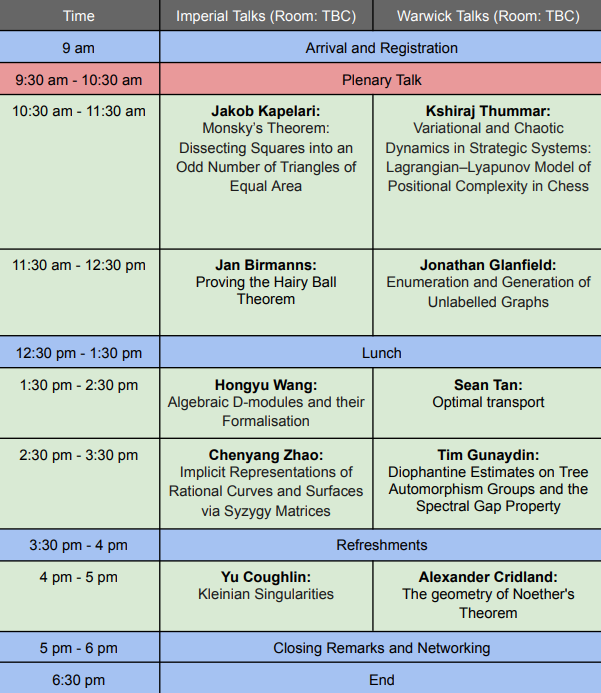
Abstracts for the student talks can be found below.
The plenary talk is TBA.
Student talk abstracts
Jakob Kapelar (Monsky’s Theorem: Dissecting Squares into an Odd Number of Triangles of Equal Area):
I would like to present a proof of Monsky’s Theorem, the surprising result that a square cannot be dissected into an odd number of triangles of equal area. The talk would follow the elegant approach in Proofs from THE BOOK. I would introduce p-adic valuations, which are used to colour the unit square based on the 2-adic valuation of its coordinates. Using an argument similar to Sperner’s Lemma we can find a triangle with a 2-adic norm of the area > 1, contradicting the required area of 1/n for odd n. Preliminary knowledge: The talk is largely combinatorial and self-contained.
Kshiraj Thummar (Variational and Chaotic Dynamics in Strategic Systems: Lagrangian–Lyapunov Model of Positional Complexity in Chess):
Traditional chess analysis relies on heuristic evaluation and tree search, offering little insight into why positions destabilize or how complexity evolves. I develop a framework treating chess as a continuous dynamical system on a 100-dimensional configuration manifold, governed by variational principles from classical mechanics. I construct a Lagrangian functional capturing the trade-off between kinetic energy (tactical volatility) and potential energy (positional evaluation). And through Euler-Lagrange equations, we get a second-order nonlinear system where positional acceleration follows the evaluation gradient. The Hamiltonian formulation reveals conserved energy-like quantities, rapid tactical changes must balance against positional quality. I have attempted to quantify chaos by Lyapunov analysis through exponential divergence of nearby trajectories. I will prove that tactically sharp positions, those with large positive Hessian curvature, exhibit exponential instability, with divergence rates bounded by the square root of maximum eigenvalues. Poincaré sections show how stable orbits disintegrate into chaos at critical thresholds. In critical positions, such as Ding Liren’s blunder in the final game of the 2023 World Championship, observing a sharp local increase in the dominant Lyapunov exponent, showing an exponential divergence of the system’s trajectory and collapse of stability. Crucially, Hessian analysis before the move predicted this catastrophe, genuine forecasting rather than the post-hoc fitting we are accustomed to. I will establish major theorems on existence, Lyapunov sensitivity, ergodicity, fractal dimension (observed ≈1.9), Pesin’s entropy relation, and variational-ergodic equivalence. Validation across 1000 grandmaster games yields ρ > 0.78 correlations between complexity metrics and error rates. Langevin dynamics with temperature-dependent noise captures human imperfection, harder positions cause more blunders across skill levels. What’s more, the math extends beyond chess. Markets crash when Lyapunov exponents surge. Evolution alternates between stasis and rapid change. Neural networks generalize near intermediate curvature regions. Intelligent systems operate where order meets chaos, where structure permits prediction but instability enables adaptation.
Jan Birmanns (Proving the Hairy Ball Theorem):
The goal of the talk would be to follow the book “Topology from the Differentiable Viewpoint” by Milnor to reach a proof of the hairy ball theorem. This would include a short introduction of smooth functions, smooth manifolds, and tangent spaces, which would then be followed by defining orientable manifolds, the degree of a function at a regular value, and smooth homotopy. After discussing some examples and important properties of the degree, such as the fact that it is preserved by smooth homotopy, I would present a sleek proof of the hairy ball theorem as discussed on page 33 of the book. If there is enough time I would also present a proof (strategy) for the properties of the degree. It is my goal to keep prerequisites as low as possible, meaning that it should in theory be enough to simply know what a derivative is. As I will be going somewhat quickly in the beginning though, familiarity with multivariable calculus and manifolds should be very helpful.
Jonathan Glanfield (Enumeration and Generation of Unlabelled Graphs):
Enumerating unlabelled graphs is a classic and notoriously difficult problem in combinatorics. Unlike labelled graphs, where each vertex has a distinct identity, unlabelled graphs consider graphs equivalent under relabelling of vertices, so counting them requires considering graphs up to isomorphism, substantially increasing the complexity of the problem. This talk presents two complementary approaches to this challenge. First, I explain how group-theoretic tools can be used to enumerate unlabelled graphs by analysing the action of the symmetric group on edge sets. I then describe a recursive algorithm for generating all non-isomorphic graphs on a fixed number of vertices, using automorphism groups to limit vertex extensions and canonical labelling to eliminate duplicates. These approaches illustrate how group-theoretic insight and algorithmic techniques can be used to attempt to tackle a classically hard enumeration problem.
Hongyu Wang (Algebraic D-modules and their Formalisation):
Algebraic D-modules serve as the foundational language of modern Geometric Representation Theory, providing an essential bridge between the representation theory of semisimple Lie algebras and the geometry of flag varieties via the celebrated Beilinson–Bernstein localisation theorem. While well- established in pen-and-paper mathematics, their implementation in interactive theorem provers remains a frontier in digitised mathematics. In this talk, based on my undergraduate thesis supervised by Prof. Travis Schedler, I introduce the formalisation of algebraic D-modules using the Lean 4 theorem prover Lean 4. We begin with an introduction to formal verification, explaining how standard set-theoretic objects map to Type Theory. We then focus on the affine case, constructing the $n$-th Weyl algebra $A_{n}(\mathbb{C})$ in Mathlib. We discuss the challenges of formalising non-commutative rings defined by generators and relations (specifically the canonical commutation relation $[\partial_{i}, x_{j}] = \delta_{ij}$) and defining D-modules as typeclass instances.Finally, we outline the roadmap from this affine foundation toward the global geometry required for the Beilinson–Bernstein theorem, illustrating how proof assistants can verify deep results in algebraic geometry. No prior knowledge of Lean or D-module theory is assumed beyond basic ring and module theory.
Sean Tan (Optimal Transport):
Optimal transport is an important topic in both pure and applied mathematics. Given two probability distributions and a cost function, we would like to “transport” one distribution to the other in an optimal way that minimises cost. This has many applications in applied maths, such as in economics, data science, biology, machine learning, etc, but more surprisingly, has applications in pure mathematics too, such as in geometric analysis and the analysis of some PDEs.In my talk I will introduce the optimal transport problem, motivate why it is such an important area of mathematics (it really is), and derive the celebrated Sinkhorn’s Algorithm, a numerical scheme for solving the problem in the discrete case. I will also go through some of my experimental results from stress-testing the algorithm on large data sets.
Chenyang Zhao (Implicit Representations of Rational Curves and Surfaces via Syzygy Matrices):
This talk studies implicit representations of rational algebraic curves and surfaces using matrices constructed from syzygies of their parametrizations. Starting from moving lines and moving planes, we explain how to build Sylvester-type and hybrid matrices whose rank and corank reflect geometric properties of the parametrized image. For plane and space curves, these matrices are obtained from the syzygy module of the parametrization and can be used to test membership and compute fiber multiplicities. We then extend the construction to rational hypersurfaces and tensor-product surfaces by using graded kernels and bidegree syzygies. In these cases, the resulting matrices give determinantal criteria for points lying on the image and allow the recovery of fibers and intersections via generalized eigenvalue problems. The methods are illustrated with examples and explicit computations in Macaulay2, with applications to geometric modeling and elimination problems.
Tim Gunaydin (Diophantine Estimates on Tree Automorphism Groups and the Spectral Gap Property):
In this talk, we consider the group of automorphisms of an infinite d-regular tree. This is a non-compact tdlc Hausdorff group. We will focus on a particular subgroup thereof, the subgroup fixing a single vertex (we call this the stabilising subgroup since the choice of vertex is often irrelevant). This group is a compact metrisable topological group with a left-invariant metric and a Haar probability measure. More importantly, it is residually finite. Using this rich structure of the group, combined with ideas from fractal geometry such as Hausdorff and Minkowski dimension, we investigate Diophantine estimates on the stabilizing subgroup. In particular, we show that a slightly weaker version of the Diophantine property holds for the stabilising subgroup of the infinite d-regular tree automorphism group, for all integers d greater than 2. Roughly speaking, this means that for almost every k-tuple chosen from the group, random products of these approximate the identity rather poorly. This has important implications in the context of the spectral gap property, which has further links to the behaviour of random walks on the group. It is also an interesting result in its own right, being a natural generalisation of Diophantine approximation on the real line.
Yu Coughlin (Kleinian Singularities)
I’ll define Kleinian singularities as quotients of C^2 by nice groups and talk about their coordinate rings as the ring of invariants, with which we can very nicely classify the singularities. I’ll then discuss blowups and compute some blowups of Kleinian singularities at the origin. From these we can associate a quiver which roughly looks like the curves in the premiage of the singular point in the Kleinian singularity which I’ll show some diagrams for, finally we see that these are the ADE diagrams, and maybe briefly mention the idea of the McKay correspondence which relates these graphs to representations of our initial group.
Alexander Cridland (The geometry of Noether’s Theorem)
In mathematical physics, notably classical mechanics, Noether’s theorem provides a rich connection between two ubiquitous concepts in the field: symmetry and conservation. Empirical laws such as conservation of momentum and energy are taken precisely as their titles imply, as laws, but Noether provides the necessary background to reframe such maxims as the consequence of a single encompassing theorem, stating that every conservation law is directly equivalent to a physical symmetry. In this way we bridge the gap between axiomatic and empirical approaches to physics and provide a unified perspective on the matter, which is of great pedagogical value. We will explore how to formulate and prove Noether’s theorem by studying the Hamiltonian formalism of classical mechanics and the language of symplectic geometry, which naturally encodes the structure of phase space dynamics. Finally, we will explore notable applications of the theorem and discuss its implications in modern mathematical physics.